Whither?
A Review of Mordecai Ze'ev Feierberg's novel Whither? (translated by Ira Eisenstein)

When I was young, my mother used to tell me many strange stories, fearful and sinister as the blackness of exile, full of sadness and darkness as Israel’s plight. The white hair on my head and my beard are not signs of age; while still a child, I became old. Each tale blanched one strand of hair; after many stories, I was completely white. Now I have come to learn that there are men who eat, drink and are merry, who do not always suffer beneath the scourge of a wrathful God; but at that time, Life to me was a vision of fearful sadness. And most dreadful of all tales was the tale of Nachman, the Madman. We children in heder always spoke of him, for we too knew his strange ways.
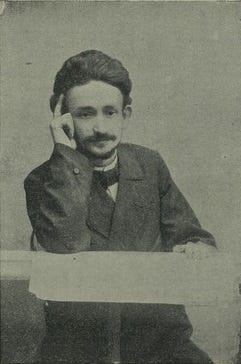
So begins Whither? by the Eastern-European Jewish novelist Mordecai Ze’ev Feierberg (1874-1899). Son of a shohet (ritual slaughterer), he grew up in two worlds: the shtetl, and the Haskalah (Jewish Enlightenment). Introduced to books outside the small village and yeshiva of his youth, he began writing stories, and then a novel, before dying of tuberculosis at 25.
His novel is marvelous.
It follows Nachman, the brilliant scion of eight generations of Rabbis, who must decide between obeying his father and studying Talmud, or joining the Haskahah and reading banned books, reading outside his culture, reading into the milieu of his age. As a child he is tormented by the demands of his studies, and treasures any moment of escape.
The heavens are clear, the beautiful sun rides proudly on the clouds, the air is pleasant and clean. This is another world. These are new heavens above him… Here he is free, here he can meditate to his heart’s content with no one to disturb him.
But he cannot escape himself, or the history of his people.
He is twelve years old today. From his earliest days, he has heard nothing but sorrow and exile, tales of fire and blood, murder and destruction. Saintly men, forced converts, slaughtered, murdered—this is his pedigree. When he was still a little child, his mother told him that his family had been among those exiled during the sixteenth century. His great-grandfather had been murdered in a small town of Volhynia, his grandfather had been killed in Kamenetz-Podolsk. Now on the rock, he recalls the stories his father would tell him from the Midrash Rabbah. Nachman wants to uproot these thoughts from his heart, to cast them to the dogs. He wants to flee. He fears himself—but where can one escape from oneself? He wants to hide from his fearful thoughts; whither can one flee from a cursed thought that has found its way, like Satan, into your heart? Whither?
His father provides an answer.
The truth of the matter is this: People cannot conceive in one stroke of a unique creator of the world. They therefore began with tree and stone, with minor forces—idolatry—progressing to the more important. Generation by generation, from age to age, they gradually approached the truth. But to us, Israel, God revealed, in a true revelation, that we are chosen by Him from among all nations to serve Him, so that He may saturate us with His spirit… I have already told you, my son, that we are warriors of God…
So Nachman is to be a warrior. But what kind of warrior? What does it mean for a Jew to be a warrior of God in Volhynia in the late 19th century?
To come back: I want to bequeath my thoughts to you, so that you may become a warrior as I am. Remember, Nachman, that my heart is broken and torn; we are an orphaned generation… I always think of Israel’s history. Whenever misery breaks forth upon us, whenever Torah is being neglected, and our nation weakens, God sets up leaders and masters of men, worth sixty myriads of ordinary men, who dedicate their lives, their energies, their wealth and their power to God and to the welfare of Israel. I always look into the books of Don Isaac Abravanel and Menasseh ben Israel. O, my son, they were indeed warriors. Warriors!
Remember that Torah is the only reality, that all else is low and vain. You must be a warrior… Now sit down and study.
There is the answer to Nachman’s whither. Where can he escape to? Into books, into the study, into the Torah to preserve the welfare of his people.
For three hours he studies on without a stop. That passage was difficult, very complicated; the commentators were waging a battle of Torah with fury and violence. This profound scholar drawing upon his learning, that master depending upon his sharp skill, and oh, what a fine battle it was! The pain seems to have passed, his very being expands again. He revels in the glow of it. Here it occurs to him to use the question raised in Zvi Hirsch’s commentary as support for the proposed solution of the Maharsha. He bubbles over with joy: another question, another battle, and a logical tower crashing down. . . . He climbs the heights, he clambers down, building castles and destroying them in the same breath. The building rises again—the stones glitter, graciously. He is so happy; there are no contradictions. He won’t have to tear it down again. Oh, he is happy!
The years pass. Painful thoughts still creep in. He sees others his age living out their lives in the sunshine, the forests, the valleys. He also sees the small errors or hypocrisies of his father’s life. What his father says one must do, what his father actually does. He sees the despair all around him, the dark dusty rooms, the Rabbis hitting their students, the beautiful world outside. He sees also that a part of his mind has been secretly at work for years, seeking any way to disbelieve in this life, in the divinity of the Torah. His years of study have been predicated on the belief that God understands the distress of his people. That “redemption can only come through divine inspiration.” He wakes one morning and realizes he no longer believes.
He likens his people to a tragic Prince who slaughtered a kingdom in pursuit of a beautiful woman, only to find her dead body in the throne room of his enemy. Now he stands there weeping eternally over his slain beloved, “imprisoned in the ruins” of his dream. Nachman calls the slain beloved Israel. And believes his people have been imprisoned by their perpetual exile, by their dream of the Holy Temple.
But you, cursed Prince, you have ceased to live a true, natural life; you have therefore ceased to play an ever-new and full role. You have been standing in one place. You have not advanced a step; your actions have not advanced. Your life for thousands of years has been but in the shadow of Life, like a dream; you see only visions of a bygone age.
Still, he loves his people, even as he pities them. A week before his marriage to the daughter of a wealthy man he thinks back to that conversation with his father.
He can still remember that morning when his father first told him that he must be a warrior. But if he does inherit the battle he cannot fight with the same weapons. His father’s sword is covered with rust; he must have a new weapon.
Yes, but what weapon? If a Jewish warrior of God in Volhynia is a Talmudic scholar, then what are his weapons? His mind, his knowledge of the Torah, his devotion? And what if such a scholar sought weapons outside the Torah, beyond his belief in God? Where would he find them?
His new wife is a lovely, enlightened woman. Her parents are kind, solicitous. But she is shocked by what she calls his ‘boorishness’ and decides to hire someone to teach him languages.
And in a short time Nachman could read and understand German. And a new world was opened to him. Books by the leading spirits were absorbed by his diligent mind in the privacy of his room. They effected a revolution in him. The Talmud and commentators, philosophers and the sages of Spain, the Shulhan Aruk and its commentators, the gaonim and their controversies, the Bet Hamidrash and all its books—all died for him. Now there existed only Spinoza, Kant, Darwin, Buckle, Spencer, et al. They filled him with their spirit; he lived and thought with them.
Most first novels are heavily autobiographical. Nachman is not Mordecai Ze’ev Feierberg, but they are close analogues. Both were born into religious Jewish communities, both were exposed to the knowledge of their time, both paid a price for it, though I will say not say what else happens to Nachman. As for Mordecai Ze’ev Feierberg, well, not every novel achieves an afterlife. Most are read and forgotten. Some live as long as their authors. Still others outlast them by a few years. But every now and then a novel will outlive its epoch. If only because some succeeding generation found in its pages the spirit of an age. Whither? is the capture of a Jewish soul in the late 19th century, and a capture of the spirit of early Zionism.
I’ll end with one of the most prescient passages in the novel.
He can look now, as into clear crystal, through nations and their gods. He sees a high wall, the wall of human culture, built stone by stone, generation by generation. He sees before him high heaps, the mass of nations’ creations for generations—and each nation of men has its own designated place. He thinks, “Yes, I will return to my people, I will lead them, I will be their guide. I have tarried enough. I am coming back! My father made me swear that I would be a warrior; I will be a warrior, but I will not stand guard over ruins. It is not well that a people should mark time on a spot; nor is it well that its men should slink off from the midst of its desolation, one by one, to other camps. Let our people gird itself in strength and go on to earn its place among the nations of the world.” . . .
Onward.
Yes, but whither?