This Is Why They Swirl
Observations at a Napa Wedding

After the wedding, when I finally returned to my apartment, I could still feel the aftereffects of the whole affair, some lingering warmth or heat in the way light fell in Napa Valley, in the green vineyards abutting the black skeletal trees of last year’s wildfires. I remember how skinny my grandfather was when I first saw him sitting in his wheelchair by a barrel outside the brewery. I remember hugging him and my cousin Jack coming up to me moments later and saying bitterly, He actually hugged you. He only put his arm on my shoulder, I said. And I tried to apologize to Jack for my grandfather, saying the old man didn’t or couldn’t understand his transition, couldn’t understand why he’d changed his name from Sara and all that went with it and all that in our shared silence while the rest of our family walked over from the cars and greeted my grandfather and we took our seats around two barrels and the waitress brought out tall glasses of beer.
And I remember the way my other cousin James attended to my grandfather, helping him drink, or making sure we always knew where his drink was, and much later in the weekend when I was sitting across from my grandfather after the wedding ceremony itself and before the reception where we were again at a high table and my grandfather was eating cheese and crackers and his caretaker was talking to someone else and I was closest to the old man and James said can you wipe his face and I saw the white cheese on the side of my grandfather’s face, by the right side of his lip and I wiped it and it is only now in writing this that I understand my cousin must have seen his father do this, wipe for his father, and the act of doing it is to him akin to the act of loving his father, for it is the way his father takes care of our grandfather. We unconsciously imitate the people we love in our lives to a degree that is defenseless and sometimes that terrifies me. What other actions have I imitated, what downsides are there to the burning depths of love?
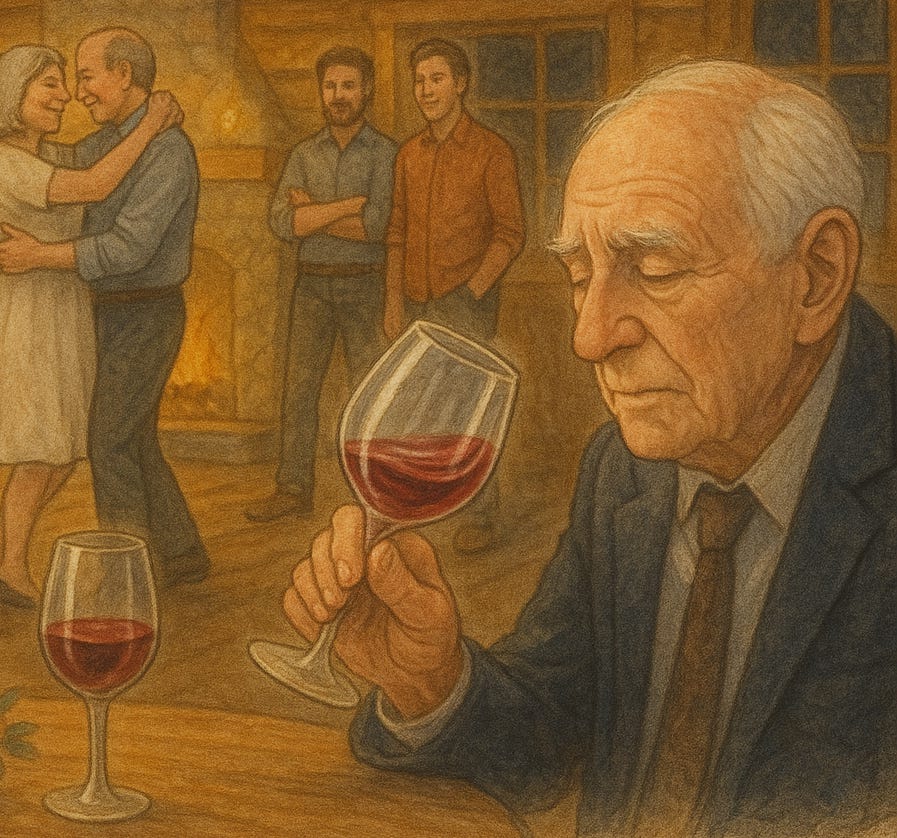
In balance, the weekend was a lovely one. We went from the beer tasting to sandwiches for lunch and then later, to an old winery where we sat a table beneath a sun umbrella while a man with curly red hair and a canvas hat with drawstrings poured us a Sauvignon Blanc, a Retaggio, and two Cabernets. The last Cabernet was their most expensive, $150 a bottle, and before we drank, he said, Smell the wine, now memorize the smell. Then he said, Swirl the wine, and my mother already knew how to and he complimented James on his vigorous swirling, and suggested not to do it at as weakly as I was, and then, after about 20 or 30 seconds, he said, Now smell the wine again, and we did, and everything smelled richer, fuller, more complete, somehow. The oxygen molecules bring out the flavor, he said. They artificially age the wine. That’s why we swirl.
He told us how the small wineries custom crush their grapes. He told us the history of the winery, how a certain Doctor C had bought 300 acres around 1852, how he’d sent for French varietals of the grapes, Bordeaux I think, how eventually a man suggested everyone in the valley grow Bordeaux and other French varietals, that they plant those instead of lettuce, instead of etc., and that he would personally buy their first crop, that was how much he believed in the grapes, in the wine. And he told us the story of how the land was sold to the S family in 1932 and how the son of the man who bought it lived in a house across the street and had lived in that house almost his entire life, only moving once, when he married, to a house on the other side of the vineyard, but had moved back into the original house after his father died, and he still lived there today.
That’s the old man we saw on the porch? asked my mother.
Yes, that’s him, said the redheaded wine guide.
And we were all silent for a moment imagining living our lives in this one place, by a single vineyard in a single valley, and never leaving, and finally being that old, and what did it mean to attach oneself to the land so deeply that one could not even imagine leaving it and what then was there to that man who sat on the porch and watched the valley slowly change, slowly remain the same, around him?
The redheaded wine guide spoke of the different wineries, and he gave them names, and it was as if they were people themselves, or contained some deeply human quality to them, and he spoke of rich men buying a crop of grapes and making wine from it and selling it for $400 a bottle and how the wine wasn’t any better, but people still paid. And how the Cabernet wasn’t that much better, at least in recent vintages, if you were paying $150 or $400, and he spoke of the wines we were drinking and how the Retaggio had been crafted deliberately after one of the S family had visited Italy and how in Italy they just hand you a case of red wine and tell you nothing about it but how well it paired with their meal. And so they wanted a wine that paired just as well and this was that Retaggio. Both James and I bought a bottle. And the guide spoke of the pure Cabernet and how this wine had come from that part of the vineyard, and he pointed just beyond the deck to a stand of grapes. And he spoke of a dispute between the former landowner, whose only surviving son had tried to sell the land in 2009, after the financial crisis, and finally sold it in 2012 to the current owners, and how there was an ancient dispute over some older section of the vineyard and how the wine bottled from those grapes now had to be named by both of the disputed parties though I don’t recall their names. He said they still had a grape vine from 1858, that it was still there, though the way he said it suggested it didn’t produce the highest quality grapes. They didn’t know about grafting back then, he said sadly.
There is more to say. I remember the Saturday night dinner with the two seven-chair tables on a raised section outside the restaurant, and how all the guests there seemed to be women. When I mentioned this to my mother she said it was because there was a famous spa nearby, a spa that the fiancée and her daughter and daughter’s girlfriend had just come from. They’d spent the day there and were utterly relaxed and the fiancée said she’d eaten so much there and the daughter said you didn’t eat a thing and it was one of those moments we let pass by but when looking at now I can see that the fiancée had this tendency to lie like that, to lie to imagine herself young and beautiful and thin, and the daughter couldn’t quite countenance that desire for perpetual youth with the deceptions required, as they had clearly been so internalized until the lie became habitual and unconscious. But the moment passed and we were told by the manager, a bearded man in his forties with a barrel torso, that we couldn’t put the two seven person tables against each other, that it was a logistical issue, and my uncle said he’d called and they said the tables would be together.
This is together, said the manager, though the tables were about six feet apart from each other.
This isn’t together, said my uncle, growing visibly madder.
The manager was having none of this, and apologized brusquely. There is nothing we can do, it is a logistical issue, he repeated.
Meanwhile the fiancée’s two adult children were already moving one of the tables closer to the other and there was gravel underneath and when the manager noticed them he said, You can’t do this.
We already did, said the son.
My uncle watched and said nothing and the manager too said nothing and turned and went back into the restaurant and came back with two waiters. Another waiter began placing small glasses of water on the table and bread plates and silverware and napkins on the tables. The manager was still displeased, frowning slightly, and my uncle told him he’d been here two years before and it had been wonderful and this time he wouldn’t tip at all.
My mother whispered to me that this was an empty threat for there is a 15% gratuity fee automatically added on for parties of our size. But my uncle had to choose anger and empty threats over any feeling of embarrassment, he had to, you could see it on his face that this was the choice he’d made and all else was simply a carrying out of a series of previously determined actions. It was as if he had no free will and I suspect the manager understood this but despised the man for it anyway and simply nodded and glanced once more at the two seven-person tables now placed together and then we ate dinner.
Both the son of the fiancée and the fiancée’s daughter’s girlfriend made an effort to talk to our side of the table and I appreciated their effort. I think the daughter is herself shy and that paired with my own shyness has left us having very little connection over the years though of course I would have enjoyed talking to her about her work, and her fluency in French and Arabic, and her growing expertise in international relations. And I talked to the girlfriend who had mast cell disease, who walked with crutches and something more, braces I think on her legs. She also had a port on the right side of her chest, just above her breasts, and carried a bottle of oxygen with her. She had a wheelchair though she didn’t always use it. She told me she wanted to be a dietitian, had just finished school at Cal (the ones who go there always call it Cal), and was going to start becoming a dietitian in the fall, would have a supervisor, and a course of general studies at various hospitals throughout the area, in Alameda, at Kaiser in Oakland, at U.C. Berkeley, and somewhere else I cannot recall. And she asked me about the novel I was working on and I tried to explain it to her. She nodded and kept mentioning how wonderful it is that people can express themselves uniquely and connect with others. (I found another woman, two mornings later, saying the same things to me, and I think now that they don’t know what to say and so retreat back to uniqueness of expression though an anxious part of me wonders if they didn’t talk to each other in between our two conversations and that is the reason for the similarity of their responses, but this is likely excess anxiety and I suspect not.)
I told her Sunday night after the wedding, when we were back at their cottage, standing around the kitchen table watching the now husband and wife drink and dance and their children drink and dance with all the music playing, I told her that I had read up for about an hour on Mast Cell Disease, that I’d thought misheard at first and thought it was Mass Cell Disease, and of course she laughed, but before she laughed there was a small tremor to her. It wasn’t that she shook. I hope you understand what I mean. It was that we are all always naturally moving, a little bit here or there, fidgeting and almost never still, and so she was suddenly very still for about a second. As I said, I’d read up on her illness for an hour, and I think it is that people expect others not to care about them or their problems, they grow used to it, that most of the world walks around indifferent to itself, and when someone suddenly pays attention to them, it shocks them and there is a sudden moment where their model of the world, the way they have come to understand it, needs adjusting, and it is that process that underpins consciousness, the model of our attention, that stops the body in its thousandfold movements and says to itself, Pay attention to this, and that is what I believe I saw.
And her name was Alice, and the now wife’s daughter was Lucy, and they all said Lucy never danced but she was dancing with Jack, both of them stomping on the floor, swaying back and forth, arms pumping, fists punching the air above them, one after the other. A few feet away James was dancing. He did this thing where he went very low to the floor with his knees extended, and then went back up to his full height just above six feet, and then back down again. The wife’s son, Richard, over on the other side of the counter was drinking, but not very much, you could tell he wasn’t very interested in getting drunk but would do so as he had learned to partake but not overdo it.
Alice was watching and perhaps she drank and perhaps she did not. She came over to me and offered me girl scout cookies for I wasn’t dancing, I just couldn’t make myself dance and I wasn’t drunk enough nor happy enough. I didn’t even envy them. What I felt was a shame at my past that had led me to become a person who stood here or sat here at the edge of a party and did not dance and I recalled all of the parties where I had not danced and the few exceptions where I had and how there wasn’t anything different between any of them, truly, but a loss of self-anxiety that comes with either alcohol or drugs or dispensing with the social worry that the other people around you actually care about your dancing.
My mother sat in a chair to my left, a few feet back, and I knew she cared. I saw her husband sitting on the other side of Richard, rapidly and awkwardly punching the air when a song he liked began playing. He was 64 and you could just tell from a distance of twenty feet that this man had never partied before or rarely or had never danced, or rarely, maybe only at his wedding, but here he was trying to join in. Though in truth the party itself was the new Bride dancing; she had changed her clothes and was wearing pants and a shirt and she danced with Jack and then Lucy and James danced next to them. And my uncle, the new husband, danced with them too, unbuttoning his shirt, the hairy chest and medium-sized belly now apparent. His dance was more of a drunken swaying, a staggering, and soon he was sitting on a chair watching them too. His son James kept calling for more shots and everyone drank and then he called for more and even my mother and her husband had one shot of tequila and I don’t know if Alice drank, but Lucy drank more and more.
And then I was dancing with the Bride, and because I never know where to put my feet she moved closer to me until her legs were on either side of my thigh and I saw my mother staring at me and I knew this was too close for a Bride and soon she laughed and we parted and I cannot (or refuse to) imagine the look on her son Richard’s face but I know he has seen this before, I know he has seen the free and happy way his mother lives and how much she loves to dance and that that perhaps is a reason why she is with my uncle, this same joy of living, of partying, of excess, of bringing out the flavor of life, of a desperation for a youth that is passing farther and farther away with every moment, a youth they have not yet learned how to give up. I don’t know if they are right or wrong to live that way.
Then we went home. My mother and her husband dropped me off at my motel. It was just past 11 pm and I took a shower with the water falling from the spout at the ceiling and I crouched down and I believe I cried and I don’t remember what at but I think it was probably how all these people would someday be dead and how the hell do you hold onto all that sorrow and joy at the same time. Who lives that way while considering every moment as beautiful because it is already past and gone? From my chair in the second of three rows at the wedding I watched from an angle as my uncle married for the second time and the rabbi, a former cantor, sang beautifully. The wind was blowing through the trees and I watched a hummingbird zip from flower to flower, hovering at each awhile or not at all, and periodically I would look around at the guests who all seemed to be focusing on the ceremony and no one seemed to be consciously looking around at the trees and the wind blowing through them. It occurred to me then that each of these things would impress themselves upon the other and I would remember that day as infused with the wind and the indifference of the hummingbird to our human ceremony and the heat of the blue sky and the way wind sounds through certain nameless trees. I fell asleep at midnight in my motel room and when I woke at 3:30 am I was short of breath and felt far drunker than when I had first fallen asleep.
And as I lay there staring up at the distant, unfamiliar ceiling, I thought back to the speech my grandfather had given. It was at the reception, which had taken place in a wine cave with a slightly sloping floor. He had stood slowly, his back bent, as we all turned our attention on him.
Time goes by so fast, he said in his ancient whisper. It goes by so fast. I am almost 96, and I can tell you, life goes by so fast. And he recalled how his son and fiancée had wanted to marry two years ago but my grandfather had broken his hip right after moving into a retirement home and so they had waited for him and now two years later…. Life goes by so fast, he repeated, as if he still couldn’t understand, after all this time, what was happening to him, what was happening to us all.
Didn't expect this take on the subject, and I found myself really struck by the quiet tension around your grandfather's interaction with Jack, wondering about the layers of unspoken understanding and love that can exsist within families, even with their complexities.